Comet Definition
kŏmĭt
comets
noun
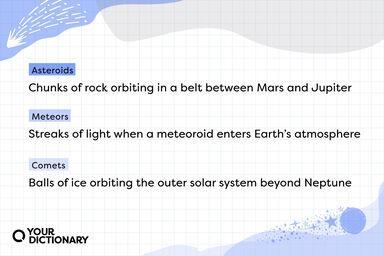
A small, frozen mass of water, gas, rocks, and dust revolving around the sun in a parabolic or elliptical orbit: as it nears the sun it vaporizes, forming a coma and, usually, a long tail of ions that points away from the sun.
Webster's New World
A celestial phenomenon with the appearance given by the orbiting celestial body.
Wiktionary
Synonyms:
Other Word Forms of Comet
Noun
Singular:
comet
Plural:
cometsOrigin of Comet
Middle English comete from Old English comēta from Late Latin from Latin comētēs from Greek komētēs long-haired (star), comet from komē hair
From American Heritage Dictionary of the English Language, 5th Edition
-
From Old French comete (French: comète), from Latin cometes, from Ancient Greek κομήτης (komētēs, “longhaired”), referring to the tail of a comet, from κόμη (komē, “hair”).
From Wiktionary
Related Articles




Find Similar Words
Find similar words to comet using the buttons below.