Cyclone Definition
sīklōn
cyclones
noun
cyclones
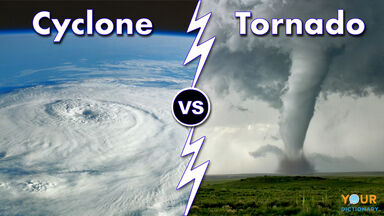
A system of rotating winds over a vast area, spinning inward to a low pressure center (counterclockwise in the N Hemisphere) and generally causing stormy weather: commonly called a low, since it coexists with low barometric pressure.
Webster's New World
A windstorm with a violent, whirling movement; tornado or hurricane.
Webster's New World
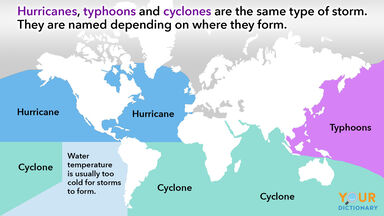
A violent tropical storm, especially one originating in the southwestern Pacific Ocean or Indian Ocean.
American Heritage
Any of various devices using centrifugal force to separate materials.
American Heritage
A strong wind.
Wiktionary
Synonyms:
Antonyms:
Other Word Forms of Cyclone
Noun
Singular:
cyclone
Plural:
cyclonesOrigin of Cyclone
Coined by Henry Piddington, probably in the 1840s, and based on some term in Ancient Greek. Sources disagree on the date and on which Ancient Greek term, though it had to be something derived from either κύκλος (kuklos, “circle, wheel”) or κυκλόω (kukloō, “go around in a circle, form a circle, encircle”).
From Wiktionary
-
From Greek kuklōn present participle of kukloun to rotate from kuklos circle kwel-1 in Indo-European roots
From American Heritage Dictionary of the English Language, 5th Edition




Find Similar Words
Find similar words to cyclone using the buttons below.