Weight Definition
wāt
weighted, weighting, weights
noun
weights
A portion or quantity weighing a definite or specified amount.
Ten pounds weight of lead.
Webster's New World
Heaviness as a quality of things.
Webster's New World
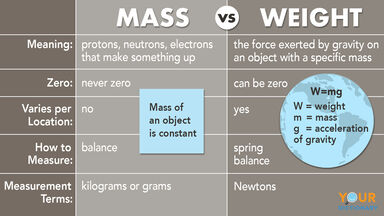
The force of gravity acting on a body, equal to the mass of the body multiplied by the acceleration of gravity.
Webster's New World
Quantity or amount of heaviness; how much a thing weighs.
Webster's New World
Any unit of heaviness or mass.
Webster's New World
Synonyms:
verb
weighted, weighting, weights
To add weight to; make heavy or heavier.
Webster's New World
To burden; load down; oppress.
Webster's New World
To treat (thread or fabric) with a solution of metallic salts, in order to increase its weight.
Webster's New World
To manage, control, or influence in a particular direction or so as to favor a particular side; slant.
The evidence was weighted against the defendant.
Webster's New World
To assign a weight to in a frequency distribution.
Webster's New World
idiom
by weight
- According to weight rather than volume or other measure.
American Heritage
make weight
- To weigh within the limits stipulated for an athletic contest.
American Heritage
by weight
- as determined by weighing
Webster's New World
carry weight
- to be important, influential, etc.
Webster's New World
pull one's weight
- to do one's share
Webster's New World
Idioms, Phrasal Verbs Related to Weight
- by weight
- make weight
- by weight
- carry weight
- pull one's weight
- throw one's weight around
Origin of Weight
-
From Old English wiht, Ä¡ewiht, from Proto-Germanic *wihtiz, *(ga)wekhtiz (cf. *weganÄ…). Compare Dutch gewicht, German Gewicht.
From Wiktionary
-
Middle English wight from Old English wiht wegh- in Indo-European roots
From American Heritage Dictionary of the English Language, 5th Edition



Find Similar Words
Find similar words to weight using the buttons below.